Joshim Kakegamic
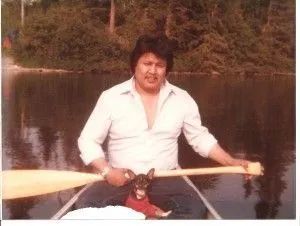
Joshim Kakegamic (1952–1993), from the Sandy Lake Reserve in Northern Ontario, Canada, was a gifted artist whose life and work were deeply rooted in Indigenous art and culture. Strongly influenced by his brother-in-law, the renowned Ojibwe artist Norval Morrisseau, and fellow Cree artist Carl Ray, he drew inspiration from their guidance, which ignited his passion for art and set him on an extraordinary creative journey.
During his formative years as a young artist, Joshim had the privilege of joining Carl Ray and Norval Morrisseau in conducting workshops at schools across the province. These experiences played a pivotal role in shaping his artistic vision. In 1969, he participated in a group exhibition in North Bay, marking the beginning of his public art career. Over the next few years, he showcased his artwork in various venues across northwestern Ontario.
Joshim Kakegamic's artistic journey took an important turn when he enrolled in a month-long workshop at Fanshawe College in London, Ontario. It was here that he discovered the possibilities offered by screen printing, which inspired him to explore new avenues for both himself and fellow artists to make a livelihood from their craft.
Upon returning to southern Ontario, he further honed his skills in screen printing techniques at Open Studio in Toronto. In 1973, with the collaborative efforts of his brothers Goyce and Henry, as well as his father David, he co-founded the Triple K Cooperative, a screen printing business based in Red Lake, Ontario. Modeled after Daphne Odjig's Indian Prints of Canada Ltd. Company, Triple K Cooperative became a trailblazing endeavor in the world of Indigenous art, reproducing prints of famous Native paintings, including those by Norval Morrisseau.
Joshim Kakegamic's artistic journey continued to flourish throughout the 1970s and 1980s. He participated in numerous exhibitions across Canada and even had the opportunity to display his work internationally, notably in group exhibitions in London, England, and Lahr, Germany. His commitment to Indigenous art and culture shone brightly through his creative expression.
Tragically, in 1993, Joshim Kakegamic's life was cut short while he bravely attempted to rescue a drowning individual. He was just 41 years old at the time, leaving behind a legacy as an artist, innovator, and advocate for Indigenous art and culture.
Joshim Kakegamic's artistic contributions and dedication to his craft, alongside his commitment to promoting Indigenous voices in the art world, continue to be remembered and celebrated by those who cherish his work and his profound impact on the Indigenous art community.
Joshim Kakegamic, né en 1952 dans la réserve de Sandy Lake, dans le nord de l’Ontario, au Canada, était un artiste talentueux dont la vie et la carrière étaient profondément liées au monde de l’art et de la culture autochtones. Il fut fortement influencé par son beau-frère, Norval Morrisseau, un artiste ojibwé renommé, ainsi que par l’artiste cri Carl Ray. Leur mentorat a éveillé sa passion pour l’art et a tracé la voie d’un parcours artistique remarquable.
Durant ses premières années en tant que jeune artiste, Joshim eut le privilège d’accompagner Carl Ray et Norval Morrisseau dans la tenue d’ateliers dans les écoles à travers la province. Ces expériences ont joué un rôle déterminant dans la formation de sa vision artistique. En 1969, il participa à une exposition collective à North Bay, marquant le début de sa carrière publique. Au cours des années suivantes, il exposa ses œuvres dans divers lieux du nord-ouest de l’Ontario.
Le parcours artistique de Joshim Kakegamic prit un tournant important lorsqu’il s’inscrivit à un atelier d’un mois au Fanshawe College à London, en Ontario. C’est là qu’il découvrit les possibilités offertes par la sérigraphie, ce qui l’inspira à explorer de nouvelles voies pour lui-même et pour d’autres artistes, leur permettant de tirer un revenu de leur art.
De retour dans le sud de l’Ontario, il perfectionna ses compétences en techniques de sérigraphie à Open Studio, à Toronto. En 1973, avec la collaboration de ses frères Goyce et Henry, ainsi que de leur père David, il cofonda la Triple K Cooperative, une entreprise de sérigraphie établie à Red Lake, en Ontario. Inspirée du modèle de la société Indian Prints of Canada Ltd. fondée par Daphne Odjig, la Triple K Cooperative devint une initiative pionnière dans le domaine de l’art autochtone, reproduisant des estampes d’œuvres célèbres, notamment celles de Norval Morrisseau.
Le parcours artistique de Joshim Kakegamic continua de s’épanouir tout au long des années 1970 et 1980. Il participa à de nombreuses expositions à travers le Canada et eut même l’occasion de présenter ses œuvres à l’international, notamment dans des expositions collectives à Londres, en Angleterre, et à Lahr, en Allemagne. Son engagement envers l’art et la culture autochtones brillait à travers chacune de ses créations.
Tragiquement, en 1993, la vie de Joshim Kakegamic fut écourtée alors qu’il tentait courageusement de sauver une personne de la noyade. Il n’avait que 41 ans, laissant derrière lui un héritage d’artiste, d’innovateur et de défenseur de l’art et de la culture autochtones.
Les contributions artistiques de Joshim Kakegamic, sa maîtrise de son art et son engagement à promouvoir les voix autochtones dans le monde de l’art continuent d’être reconnues et célébrées par ceux qui chérissent son œuvre et l’impact profond qu’il a laissé dans la communauté artistique autochtone.
